
Can Kosovo Power an AI Data Center?
A plain-language guide to new report findings on the feasibility of building an AI data center in Kosovo.
Table of Contents
Executive Summary
Given the increasing demand for artificial intelligence, with uses ranging from personal chatbots offering relationship advice to AI-powered medical imaging and diagnosis, the need to power these systems has become especially pronounced. These AI tools require immense data storage and parallel processing which are both electricity intensive. AI data centers house the specific infrastructure that facilitate the energy and cooling demands of AI. As such, with the spread of AI, we need a corresponding rise in the data center industry.
Since AI workload is expected to double in the next 5 years, it is forecasted that the global data center industry will increase by 14% per year. This transition means demand will move from a few centralized locations to more distributed regional hubs to reduce latency. This is where Kosovo can come in. In our research, we ask whether Kosovo can credibly host an AI data center in a way that passes an internal investment committee.
This research was prepared by the ZANI team to support Albanians for America in making a fact-based, non-promotional case to multinational technology corporations. It is explicit about what it’s for: an internal diligence-grade assessment, and an input to preliminary discussions toward a potential Memorandum of Understanding (MOU) with the Government and corporate decision-makers. The goal is simple: identify where Kosovo already meets investability thresholds, where it does not, and how constraints can be adequately addressed.
Kosovo is not “ready-made” for a hyperscale AI data center today, but it can be investable—if the project starts at the right scale, secures power and process certainty early, and expands only as grid capacity, redundancy, and institutional execution improve.
That thesis is grounded in a broader industry shift. AI-driven demand is pushing data centers toward new geographies as grid connection delays, construction cost increases, and power constraints tighten in established hubs. Within that frame, Kosovo is presented as an underutilized European location with cost advantages, available land, and a technically developed transmission system, while also acknowledging the central caveat: the electricity system “momentarily lacks scale, redundancy and price stability.”
The report treats electricity as the main diligence issue because AI data centers are energy-intensive, require uninterrupted supply, and typically need high-voltage access—400kV for large facilities and 220kV for medium facilities. On the grid backbone, it points to substantial assets: 51 transmission substations, 1,410.5 km of transmission network, and 6,608 MVA of total transformer capacity. It also details interconnections, including 279.5 km of 400kV lines connected with Albania, North Macedonia, Montenegro, and Serbia. The transmission system is developed enough to handle large power flows, which is a prerequisite for any serious project.
The report also flags practical institutional progress that matters for market credibility. Kosovo’s market coupling with Albania through ALPEX is presented as a real mechanism. For 2024 day-ahead trading, the report cites around 1.17 million MWh traded (meaning the volume of electricity exchanged on the day-ahead market that year), an average clearing price of €112.01/MWh (meaning the typical market price per megawatt-hour), and total invoicing of €301 million (meaning the total value of purchases and sales processed).
On the macro and cost side, the report frames Kosovo as stable enough for long-lived, capital-intensive assets. It describes real GDP growth stabilizing at approximately 4% annually, with projections of 3.9% in 2024 and around 4.0% in 2025. Inflation is reported at approximately 2.4% in 2024, and public debt at approximately 20.6% of GDP—reducing sovereign-risk exposure in the report’s framing. It also notes Kosovo’s first sovereign credit rating from Fitch Ratings (BB-, stable outlook), and that euro usage eliminates foreign-exchange risk for multinational investors.
The “cost advantage” argument is specific: lower industrial land prices and construction costs compared to Western Europe and established Central European hubs, plus evidence that the domestic construction sector can absorb large projects—construction investments exceeded €1.1 billion in 2022, representing over half of total enterprise investment. The tax structure is also treated as a durable feature: a flat 10% corporate income tax and 18% VAT, with the ability to negotiate incentives like tax holidays, accelerated depreciation, and customs exemptions for imported equipment within the policy environment described.
Finally, the report makes the “operating base” argument through people and connectivity. Kosovo’s demographics are framed as a long-run advantage: more than 55% of the population under 30, about 31% under 18, and a median age of roughly 29.5 years. ICT employment grew from 9,379 workers in 2019 to 13,048 in 2023—39% growth—which the report treats as evidence of an expanding talent base. It also cites 106 vocational and training centers nationwide as a practical channel for scaling technician and operations training. Digital readiness is anchored with an internet penetration estimate of approximately 97%, more than 11,000 workers employed in ICT services, and over 90% of IT firms exporting services to EU and North American markets—evidence of familiarity with international standards.
The research does not, however, minimize the risks that decide these projects.
Energy is the big one. The report notes Kosovo has historically consumed more electricity than it produces, creating structural dependence on imports and exposure to regional price volatility. It describes production fluctuating roughly between 5,000 and 6,300 GWh per year, while consumption peaked at 6,885 GWh in 2021 and stabilized around 6,600 GWh in 2024. In plain terms, that means large new demand has to be staged carefully, or it will collide with system limits and price risk. The sustainability question is also direct: almost 80% of electricity production is described as coming from thermal power plants, based on a referenced 2023 annual report. And cross-border politics show up as a reliability issue, with the report noting Kosovo’s 400kV interconnection with Serbia remains blocked for commercial operation, increasing reliance on the Kosovo–Albania corridor.
Process risk is the other decisive constraint. The report cites that construction permitting can require 14 steps, an average of 255 days, and costs equivalent to 22.4% of project value. It also flags digitization delays and partial in-person submission requirements as practical friction for foreign investors operating remotely. If timelines are not credible, capital does not move.
So what would need to be true for this project to work?
First, the project would need to start small or medium and scale only as supply, redundancy, and grid capacity improve. Second, it would need long-term electricity contracting that materially reduces exposure to import price spikes, which the report explicitly treats as a real risk. Third, it would need direct high-voltage connection (400kV or 220kV), supported by a dedicated on-site or near-site substation and battery storage to improve reliability and avoid distribution losses. And on the public side, Kosovo would need a credible investment pathway that modernizes administration, digitizes approvals, and stabilizes commitments through an MOU so that permitting, land, and grid obligations are clear and less exposed to procedural drift.
If you’re a policymaker, the next step is not announce a “megaproject.” It’s to lock in the enabling conditions that make diligence easier: a clear pathway through permitting, a credible grid connection plan, and a negotiation posture that treats reliability and transparency as core assets.
If you’re an investor, the immediate work is as follows: validate power availability at the right voltage, map redundancy and failure modes, stress-test price exposure, and test whether the institutional commitments can hold over the life of the asset.
And if you’re part of the diaspora looking for something concrete, the report’s bet is modest but meaningful. Kosovo can become a credible, underutilized option in Europe for AI infrastructure, so long as the scope matches the system realities and the risk controls are designed in from day one.
Energy Power System Assessment for an AI Data Center in Kosovo
This section aims at assessing the electricity system of Kosovo towards potentially building an Artificial Intelligence (AI) data center. In the industry 5.0 era, AI is developing at tremendous speed, which means that data generation is at the highest levels ever. This raises the need to build industrial facilities, such as data centers, which are the most energy-intensive facilities. These data centers require large amounts of electricity, access to high power grid or voltage levels such as the 400kV for large facilities, 220kV for medium facilities and 220 kV for small facilities. Uninterrupted supply and strong power grid infrastructure is very important. In addition, AI data centers process a lot of information releasing heat, which makes it essential to have strong cooling systems in place that cannot fail if an outage happens.
Given all of the above, the main question of this memo is whether Kosovo as a country has reliable and affordable electricity to power an AI data center.
In the following sections, we will address the country’s historical electricity data such as production, consumption, imports and prices. In addition, we identify some strengths, risks and mitigants which are concluded with some recommendations.
Background on AI Data Centers:
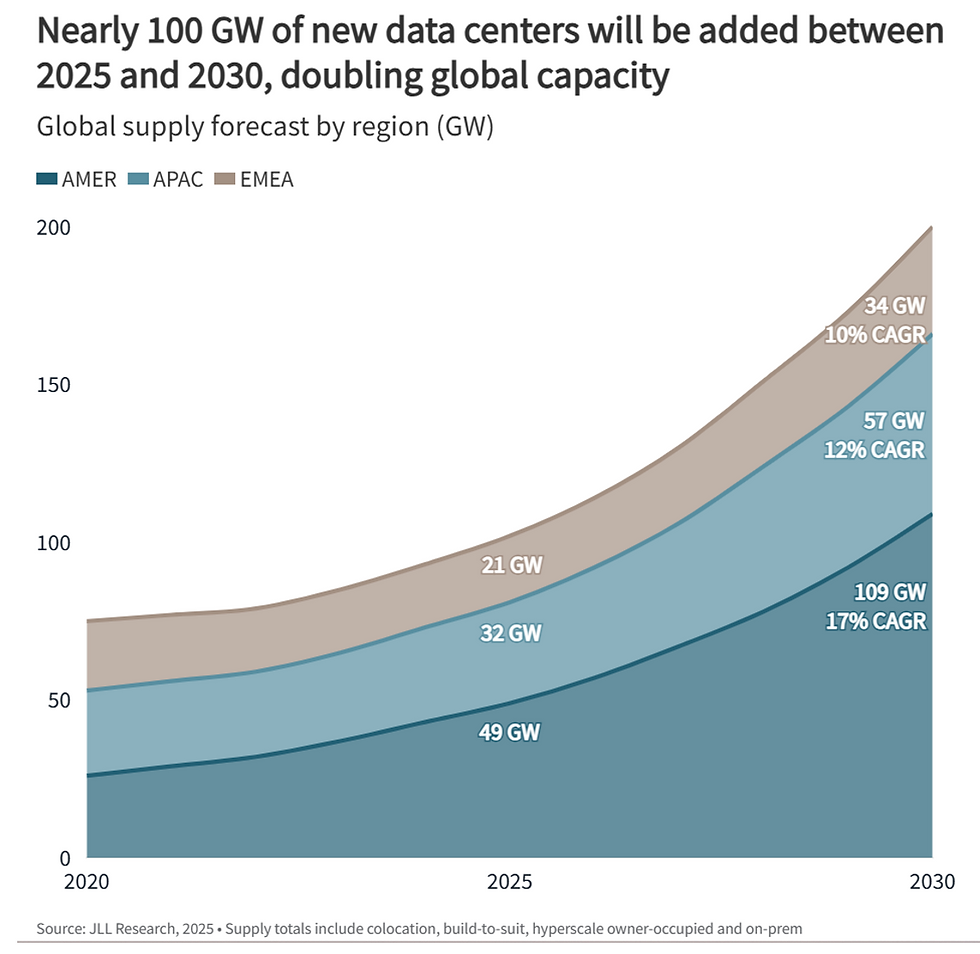
According to JLL Research (2025), the global data center industry is growing at a fast pace, mainly due to AI and cloud computing.[1] Because the AI workload is expected to double in the next 5 years, it is forecasted that the capacity of datacenters will increase with 100 Gigawatts worldwide, resulting in a 14% growth rate per year in this sector. This transition means demand will move from a few centralized locations to more distributed regional hubs to reduce latency.
These estimations have raised the question of electricity supply to keep the facilities up and running. JLL states that “grid connection delays, rising construction costs, and power constraints are pushing operators toward on-site power generation, battery storage, and direct investment in energy infrastructure. Building data centers is also becoming much more expensive, with construction costs rising to over $11 million per megawatt and AI-specific fit-outs adding up to $25 million per megawatt. Altogether, the sector may require close to $3 trillion in total investment by 2030.”


Data centers worldwide and in the Balkans:
Data center map shows that there are 10,513 data centers listed, from 174 countries worldwide. Below the figure shows a map of a few of those data centers in the Balkans and a part of Europe.[2] However, it is not clear if these data centers are purely or solely AI data centers. There seems to be one data center in Kosovo and four in Albania. The data center in Kosovo is called Illysoft LLC and is described in official webpage as a “data center solution for organizations requiring a southeast presence in Europe, offering to clients a highly secure, dependable, uptime guaranteed and affordable location to colocate in the Balkan/Kosovo.”[3]

We looked at existing AI data centers in Europe and the patterns are quite clear. For example, in the case of Ireland, the country attracted large investments in data centers due to an already existing digital ecosystem which is perceived as one of the strongest in Europe. It is estimated that data centers in Ireland consume 22% of national electricity,[4] putting a lot of stress on the power grid and calling for policy restrictions.[5]
Another example is the Nordic Countries which have a cool climate, extensive renewable energy resources and a strong infrastructure. These elements imply lower operating costs and system cooling needs which is essential for the AI data centers.[6]
The European Union as a whole is increasingly facing challenges linked to the rapid growth of data centers. In the EU only, data center electricity use is estimated at around 70 terawatt-hours in 2024, with projections reaching 115 terawatt-hours by 2030. A key challenge for the energy system is not only the scale of this growth, but the speed at which new data centers seek grid connections. This creates pressure on electricity networks, energy efficiency, decarbonization, and water use, raising the need for major upfront investments in grid reinforcement.[7]
Compared to these cases, similarly to these countries Kosovo has lower historical electricity prices, cool climate as well as land and transmission infrastructure available. However, the electricity in the country momentarily lacks scale, redundancy and price stability. Furthermore, differently from EU countries, Kosovo faces geopolitical risks especially in the electricity import-export relations with Serbia.
Electricity infrastructure in Kosovo:
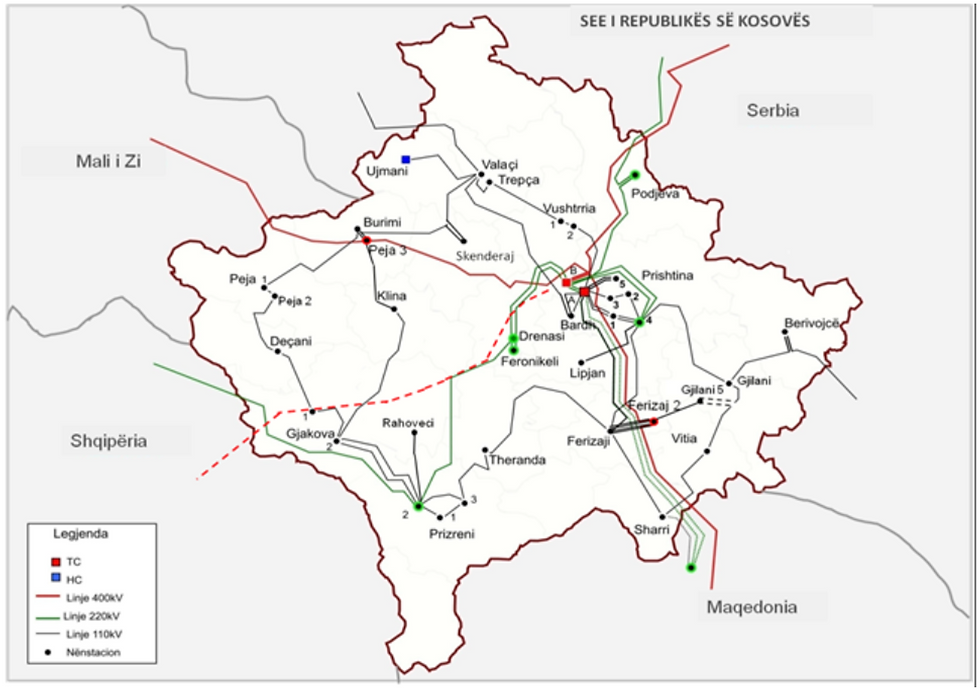
The annual reports from the Electricity Regulator Office (ERO) show that infrastructure in Kosovo is made of Thermal Power Plants (TPP), Hydropower Plants (HPP), transmission substations (51) and transmission network (1,410.5 km).[8] The total transformer capacity is 6,608 MVA.[9]
The transmission network is connected with neighboring countries as described in the following table:
Transmission lines | Countries | Infrastructure length in km |
400 kilovolt lines | Kosovo, Albania, North Macedonia, Montenegro, Serbia | 279.5 km |
220 kilovolt lines | Kosovo, Albania, Serbia | 238.5 km |
110 kilovolt lines | Serbia | 892.5 km |
The Distribution System includes medium voltage level 35kV, 20kV, 10kV, 6kV and low voltage level 0.4kV. This shows that the country has a technically developed transmission system, capable of large power flows.
The image below shows the location of the infrastructure in the map.
The 2023 Annual report shows that almost 80% of electricity is produced from TPP, raising concern over the environmental aspect of electricity production in Kosovo.[10]
Electricity balance in Kosovo: Production, Consumption, and Imports Kosovo is home to 1,614,003 citizens[11], which is an important factor in the energy demand and electricity needs. The country produces a large share of the electricity it needs inside the country. Figures 6-8 contain data from annual reports from the Energy Regulatory Office (ERO)[12] for the years 2011-2024.
The figures show that the country has mostly consumed more than it produces electricity, raising the need for imports to balance the system. Another strategy of the government is to sell electricity when prices in the region peak and to buy when prices in the region drop. Besides the market conditions (prices), the cross-border trade depends on the contracts and availability of transmission capacity.
This gives the country a bit of flexibility in offsetting costs from energy imports, making the energy system more reliable.
In the case of an AI data center in Kosovo, the above-mentioned points are important because a large increase in electricity demand would lead to an increase in imports or on new electricity generation investments.

Figure 6 shows that electricity production in Kosovo fluctuates between roughly 5,000 and 6,300 GWh per year, while electricity consumption shows a clear long-term upward trend, peaking at 6,885 GWh in 2021 before stabilizing around 6,600 GWh in 2024.

Figure 7 shows that the net energy balance is negative in most years, confirming that Kosovo is structurally dependent on electricity imports. Figure 8 shows that total energy purchase costs vary significantly from year to year, reflecting exposure to regional electricity price volatility rather than just the size of the energy deficit.
Electricity prices:
It is true that AI data centers require large investments usually measured per MW, but operating costs are one of the main expenses. Electricity is estimated to count for 30-60% of total operating costs for large data centers.[13] For this reason, it is important to have a look at the prices.
In 2024, ERO reports the following:
Electricity price for households: €7.39 per KWh
Average electricity price for non-household customers (businesses): €9.30 per kWh
Average import market reference price: €122.76 per MWh (2024) and €129 per MWh (2023)
Import prices were lower in 2024 than in 2023, but still volatile and market-driven
Electricity prices through the years show that Kosovo has relatively lower energy prices compared to EU countries due to lower cost of production, as well as regulated tariffs and subsidies (which are being reduced). However it is important to note that Kosovo is transitioning towards market-based pricing for large energy consumers who have to move towards open markets to secure the amount of electricity needed.
For an AI data center it is important to emphasize that electricity prices in Kosovo are competitive in the short-term, while contracts are needed to guarantee those prices in the long term. A key takeaway is that import price spikes remain a real risk, thus a generator or substation should be considered.
Lastly, related to the prices, the figure below is extracted from an OECD report on the energy sector for Kosovo. The recent data refers to the first trimester of 2024, showing that energy prices for average household and non-household consumers are lower compared to neighboring and other Balkan countries.[14] This is an important consideration for large electricity consumers such as AI data centers.

Carbon-neutral Energy Target:
The figure below is extracted from the 2024 annual report from ERO. It practically shows that energy produced by hydropower plants (HPPs) and Renewable Energy Sources (RES) is very low compared to the energy produced from Thermal Power Plants or fossil fuels. This raises concerns over sustainability in the long term. OECD (2024) highlights the need to shift from carbon-extensive energy production as the country relies a lot on fossil fuels, towards a green and sustainable energy system.[15] Renewable energy auctions in the region are promising towards increasing the RE capacity.

Distribution system and losses: The annual reports show that the distribution network has improved over years, but losses and outages still remain a challenge. Only in 2024, 1.27% of energy entering the transmission system counts for transmission losses, while 15.6% of distribution demand (or 974 GWh) counts for distribution losses, indicating inefficiency in the system. However, this does not necessarily impact on the AI data centers, as they would directly be connected to high voltage and not on the distribution level.
Cross-border constraints as a reliability issue: Despite the earlier-described inter-connection lines in place, in practice Kosovo’s most reliable high capacity 400kV line is with Albania. The interconnection line of 400kV with Serbia remains blocked for commercial operation due to the political and regulatory disputes between the two countries. This situation continued in the past few years creating difficulties in electricity trading and balancing the system.
Kosovo-Albania electricity market (ALPEX): Kosovo and Albania have been working for years to connect their electricity markets through ALPEX, so they can trade power in a more organized and transparent way. The idea started after the Western Balkans commitments and the EU “third energy package” goals and then moved step by step. The 400 kV interconnection line between the two countries was finalized in 2016 but put into regular operation in December 2020 following the implementation of the agreement between KOSTT (transmission system operator in KS) and TSO (transmission system operator in Albania). The purpose was to operate as a regulatory block within ENTSO-E.[16]
For 2024 day-ahead trading, the reported indicators show meaningful activity and cross-border flows:
Total Day-Ahead volume traded (2024): 1,172,580.58 MWh
Average clearing price (2024): €112.01/MWh
Energy flow (2024):
Albania → Kosovo: 27,816.94 MWh
Kosovo → Albania: 241,097.29 MWh
Purchase offers: 1,534,425.97 MWh
Sale offers: 1,868,626.34 MWh
Total invoicing (purchase/sale): €301 million[17]
Risks and mitigants:
In the table below, a summary of the risks is given, supported back to back by some mitigants:
Risks | Description | Mitigation |
Electricity supply and reliability | Consumption exceeds production, leading to imports to balance the system. A large AI Data Center would increase demand, putting more stress on the power grid. | A new substation or power generator may be needed to ensure a reliable and uninterrupted power supply. |
Powergrid efficiency | Distribution network has improved over the years, but losses and outages still remain a challenge, leading to power grid inefficiencies. | Direct high-voltage connection for an AI data center feasible in the 400 kV and 220 kV lines. |
Price volatility | The country is exposed to volatility of regional import prices. Transition towards market-based pricing increases uncertainty for long-term operational expenses. | Kosovo–Albania market coupling (ALPEX) improves transparency, coordination, and flexibility in cross-border electricity trading. |
Cross-border politics | The geopolitical situation also impacts on the electricity sector. The 400 kV interconnection with Serbia is currently constrained for commercial use, limiting the import capacity. | Reliance on Kosovo-Albania Corridor is increased. Also, the government has shown the ability to offset part of import costs by selling electricity during peak price periods and buying during lower-price periods, which can partially mitigate financial exposure. |
Cooling system | AI Data centers release a lot of heat making it extremely important to have a cooling system in place that is functional 24/7. | The relatively cool climate of the country may imply lower operating costs for an AI data center. |
Environmental and sustainability concerns | Around 80% of domestic electricity production comes from thermal power plants, raising environmental concerns and potential future regulatory pressure. | Renewable energy auctions in the region are promising towards increasing the RE capacity. An AI data center could also integrate on-site renewables and closed-loop cooling systems to reduce its environmental footprint. |
Recommendations:
Start small and scale carefully: Kosovo is better suited for small or medium AI data centers at first. Larger facilities should only be considered once electricity supply, redundancy, and grid capacity improve.
Lock in contracts early: The AI data center should secure long-term electricity contracts and, where possible, dedicated supply. This is necessary to reduce exposure to volatile import prices and ensure stable operating costs.
Connect directly to high voltage: AI data centers should connect straight to the 400 kV or 220 kV network supported by a dedicated on-site or near-site substation, and storage battery. This avoids distribution losses and improves reliability.
Link projects to renewables and resilience: New data centers should be tied to renewable energy development and designed with strong backup and cooling systems. This reduces environmental risk and improves long-term viability.
Human Capital and Society
Kosovo offers a compelling opportunity for large technology companies looking to build AI data centers. Although Kosovo is not yet an established tech hub, they are still worth serious consideration. We have found three main points to support this argument: a young population that supports long-term workforce availability, an existing and growing ICT talent base that can be scaled through education and training, and job conditions where data center roles could meaningfully improve retention of skilled workers in the country.
Kosovo has the necessary demographics to support a project of this kind: Kosovo has one of the youngest populations in Europe. More than 55% of the population is under 30, and about 31% is under 18, with a median age of roughly 29.5 years.[18] When choosing to invest in a new country, tech companies must be confident that the talent pipeline will exist not just today, but for the future as well. Kosovo’s demographics reduce long-term labor risk by ensuring a renewable workforce that can be trained, upskilled, and retained as the data center scales and evolves.
Kosovo can build and scale the skills pipeline needed over time: Building on the point above, Kosovo not only has the people, but also the capacity to train and upskill them. Evidence from Kosovo’s ICT (Information and Communication Technology) labor market suggests this pipeline is already expanding. According to an Open Data Kosovo and USAID workforce analysis, universities in Kosovo enroll several thousand students each year in ICT-related bachelor’s and master’s programs, with enrollment increasing between the 2021–2022 and 2022–2023 academic years.[19] This indicates a steady flow of graduates entering technical fields.
At the same time the employment in the information and communication technology sector also grew from 9,379 workers in 2019 to 13,048 workers in 2023, representing 39% growth since 2019.[20] This expansion shows us that Kosovo’s education and training systems are already producing workers who can enter and adapt within technical fields.
The workforce analysis also shows that the largest share of ICT workers are in the 25–34 age group, meaning the sector is largely made up of recent graduates and early-career professionals, meaning AI data centers will have a steady pipeline of trainable technical talent that can grow in their roles over time.
Finally, Kosovo also has strong non-academic training capacity which is critical for AI data center roles that rely on certifications and hands-on operational skills rather than just advanced degrees. The workforce report identifies 106 vocational and training centers nationwide, meaning an AI data center could quickly scale technician and operations training through existing public and private providers, expanding access to stable technical careers.
AI data center jobs could help reduce brain drain in Kosovo: Kosovo continues to experience high emigration, particularly among young and skilled workers, as many people leave in search of better job opportunities abroad. A large share of the economy depends on money sent home by Kosovars working overseas, which helps families but also highlights a challenge: many of the country’s most capable workers are building their careers outside Kosovo. This ongoing brain drain is a concern because it reduces the domestic supply of skilled labor, weakens long-term economic growth, and makes it harder to develop advanced industries that rely on experienced technical workers.[21]
ICT centered roles tend to offer stable, long-term employment, and wages that are competitive relative to local alternatives.[22] These characteristics are still relatively rare in the broader labor market.
By creating visible, well-paid technical roles with growth potential, an AI data center could help increase incentives for some workers to build long-term careers at home rather than viewing migration as the default path to stability. While this would not eliminate emigration entirely, it could meaningfully improve retention among early-career and mid-career technical workers, strengthening Kosovo’s human capital base over time and making future skills development more sustainable.
In implementing an AI data center in Kosovo, there are two main potential concerns to consider as it relates to the nation’s human capital needs: (i) educational quality gaps and (2) language proficiency.
Education quality gaps may limit the speed of skills development: While Kosovo has a young population, international assessments point to weaknesses in foundational education outcomes. Programme for International Student Assessment (PISA) results show Kosovo scoring significantly below Organisation for Economic Co-operation and Development (OECD) averages, including a reading score of approximately 353, which is lower than many neighboring countries.[23] This suggests that a portion of the workforce may require additional foundational training before moving into technical or operational roles.For an AI data center, this does not make workforce development impossible, but it does mean that companies may need to invest more heavily in on-the-job training, standardized certification programs, and structured upskilling to reach required operational standards.
Language proficiency could constrain certain roles without targeted support: English proficiency in Kosovo is moderate by regional standards. EF’s English Proficiency Index places Kosovo (Prishtina) in the mid-range, with scores roughly between 545 and 586.[24] While this level is generally sufficient for basic professional communication, it may pose limitations for roles that require advanced technical documentation, cross-border coordination, or close integration with global engineering and operations teams.This risk is manageable but implies a need for targeted language training, particularly for supervisory, documentation-heavy, and escalation roles within a data center environment.
To help overcome and find solutions to these risks there are three practical options that we suggest:
Firstly on training programs we recommend an employer led training and certification programs that can bridge the gaps and that focuses on applied, job specific skills rather than formal academic credentials. An example of this is the “Microsoft Datacenter Academy, which collaborates with local education partners to create pathways into the datacenter industry. “ At the same time, these programs can incorporate targeted technical language training, integrating job-specific English terminology directly into daily operations. This combined approach allows workers to develop both technical capabilities and functional English skills.
Secondly, risks can be reduced through paid apprenticeship programs, a model widely used in countries with strong economies. Students can participate from late high school or early university stages, gaining early exposure to technical and operational environments. Apprenticeships help build loyalty in a small labor market, allow employers to train workers in highly specific roles, and align well with Kosovo’s strong work ethic and young demographic profile.
Lastly, risks can be further mitigated through institutional partnerships and supportive policy incentives, including collaborations with schools and universities that adapt curricula to match real operational needs. Aligning education programs with the job market in Kosova, helps produce job ready talent and as well strengthen long-term collaboration between the private sector and Kosovo’s higher-education ecosystem.
Economic and Financial Assessment of Kosovo as a Location for Hyperscale Data Centers
Purpose and Analytical Framework:
This section evaluates whether Kosovo represents a financially viable and strategically sound location for large-scale data center investments by global technology companies. The analysis focuses on four determinants of hyperscale investment decisions: (i) macroeconomic and fiscal stability, (ii) capital and operating cost competitiveness, (iii) taxation and investment incentives, and (iv) key financial risks and mitigation mechanisms.[25]
The objective is to provide a fact-based, non-promotional assessment suitable for internal investment committees and to inform preliminary discussions toward a potential Memorandum of Understanding (MOU) with the Government of Kosovo.
Macroeconomic and Fiscal Stability:
Kosovo has demonstrated a stable macroeconomic trajectory in recent years, a key prerequisite for long-lived, capital-intensive investments such as data centers. Following the contraction caused by the COVID-19 pandemic in 2020, real GDP growth rebounded strongly in 2021 and has since stabilized at approximately 4% annually. Official projections indicate GDP growth of 3.9% in 2024 and around 4.0% in 2025.[26]
Inflationary pressures that peaked in 2022 have eased significantly. Inflation declined to approximately 2.4% in 2024, contributing to a more predictable cost environment for long-term operational planning. Public debt remains low by European standards, at approximately 20.6% of GDP, limiting sovereign risk exposure.[27]
Kosovo has received its first international sovereign credit rating, with Fitch assigning a BB- rating and a stable outlook.[28] While below investment grade, this rating reflects improving institutional credibility and reduces perceived country risk. Kosovo’s use of the euro as legal tender eliminates foreign-exchange risk, an important consideration for multinational investors.
Capital and Operating Cost Competitiveness:
Capital Expenditure (CapEx): Data center investments require substantial upfront capital for land acquisition, construction, grid connection, and specialized equipment. Kosovo offers a structurally lower-cost environment than Western Europe and established Central European data center hubs. Industrial land prices and construction costs are lower, reflecting wage differentials and less restrictive zoning and permitting regimes.[29]
The domestic construction sector has demonstrated the capacity to absorb large-scale investments. In 2022, construction investments exceeded €1.1 billion, representing over half of total enterprise investment, indicating both technical capability and scalability.[30]
Operating Expenditure (OpEx): Although data centers are not labor-intensive, they require a reliable workforce for technical operations, facilities management, and security. Kosovo offers relatively low wage levels compared to EU member states, combined with high English proficiency and digital literacy, supporting lower long-term operating costs.[31]
Kosovo’s ICT sector reinforces this operational base. Internet penetration is approximately 97%, and more than 11,000 workers are employed in ICT services.[32] Over 90% of IT firms export services to EU and North American markets, indicating familiarity with international standards and operational requirements.[33]
Taxation and Investment Incentives: Kosovo’s tax regime represents a structural competitive advantage. The corporate income tax rate is a flat 10%, significantly below EU averages. VAT is applied at 18%, with exports zero-rated and reduced rates applied to essential goods and services.[34]
Kosovo has concluded multiple double-taxation treaties and maintains a legal framework protecting foreign investors. The policy environment allows for negotiated incentives, including tax holidays, accelerated depreciation, and customs exemptions for imported equipment,
Financial Risks and Mitigation:
Key investor-relevant risks include energy reliability, regulatory predictability, and perceived political risk. These risks are typical of emerging markets but can be mitigated through long-term power purchase agreements, dedicated grid investments, stabilization clauses within an MOU, and potential involvement of international financial institutions.
Investor Assessment:
From a financial perspective, Kosovo represents a credible and increasingly competitive location for hyperscale data centers, particularly for firms seeking geographic diversification, lower total cost of ownership, and long-term strategic optionality within Europe.
Economic and Fiscal Rationale for Hosting Large-Scale Data Centers in Kosovo
Purpose and Policy Context:
This section assesses the economic and fiscal rationale for supporting large-scale data center investments in Kosovo. It evaluates whether such investments generate durable national value through foreign direct investment (FDI), infrastructure upgrading, fiscal sustainability, and long-term economic diversification. The analysis is intended to inform government decision-making in the context of negotiating a Memorandum of Understanding (MOU) with global technology firms.
Macroeconomic and Fiscal Position:
Kosovo’s macroeconomic environment provides a stable foundation for hosting large-scale infrastructure investments. GDP growth has stabilized at approximately 4% annually, inflation has declined to around 2.4%, and public debt remains low at approximately 20.6% of GDP, preserving fiscal space.[35] Kosovo’s first sovereign credit rating (BB-, stable outlook) signals improving institutional credibility and supports the country’s positioning in discussions with multinational investors and international financial institutions.[36]
Foreign Direct Investment and Economic Diversification:
A single hyperscale data center can represent FDI of several hundred million euros, materially exceeding Kosovo’s average annual FDI inflows. Such investments would contribute to diversifying FDI away from real estate and other non-tradable sectors.[37]
Data centers are export-oriented digital infrastructure assets, aligning with Kosovo’s strategic need to strengthen tradable sectors and reduce reliance on consumption- and remittance-driven growth.
Infrastructure and Fiscal Spillovers:
Data center investments generate substantial indirect economic effects. During construction, they create demand for local construction, engineering, and logistics services. During operation, they support maintenance, security, telecommunications, and energy services. Importantly, such investments often require grid reinforcement, substations, and fiber-optic infrastructure. When appropriately structured, these assets remain public and improve system-wide reliability for households and businesses.
From a fiscal perspective, data centers contribute through corporate income tax, payroll taxes, social contributions, and local fees. More importantly, they provide a stable and predictable tax base over long operating lifespans.
Policy Risks and Mitigation:
The main public policy risks include limited direct employment effects and public concern regarding energy usage. These risks can be mitigated through transparent communication, requirements for new generation capacity, and linking data center investments to broader infrastructure upgrades. Kosovo’s strong fiscal position allows for time-bound, conditional incentives without undermining fiscal sustainability.
Government Assessment:
From a public policy perspective, large-scale data center investments represent a strategic opportunity to attract transformative FDI, modernize national infrastructure, and reposition Kosovo within the European digital economy. Under a clearly defined MOU framework, the long-term economic and fiscal benefits are likely to outweigh the associated risks.
Infrastructure and Location
Overview:
To accurately assess data center investments in Kosovo, policymakers must look beyond traditional real estate frameworks. The industry is currently shifting toward AI and High-Performance Computing, which requires a fundamental change in how facilities are designed. To remain competitive, new developments in Kosovo must prioritize modern physical infrastructure capable of supporting the intense power and cooling demands of next-generation hardware.
A data center is best understood as a facility that converts incoming electrical power and connectivity into reliable compute, while continuously removing the heat that compute produces. The starting physical constraint is the site’s deliverable IT critical load (MW) and how that load is distributed as power density (kW per rack). Because density determines not only how much power you need, but how concentrated the heat will be and how difficult it is to cool. Industry planning discussions commonly describe “traditional” racks around a few kW, “high density” around ~10 - 30kW/rack, and much higher densities for advanced workloads.[38] This shift drives more robust distribution and larger supporting electrical rooms and equipment footprints. Reliability targets translate into real physical additions—UPS systems, battery footprint, generators, fuel storage, and separated distribution paths—that materially affect building layout and site planning.[39]
A crucial consideration in planning these facilities is that almost all the electricity that servers use is converted directly into heat, which means the cooling system must be capable of removing roughly the same amount of energy that the servers consume.[40] Consequently, a site’s viability in Kosovo depends not only on the availability of land for development, but also on its environmental engineering potential. This refers to how well the local climate supports energy-efficient cooling and whether the physical infrastructure can withstand key risks such as seismic activity and water scarcity. This analysis evaluates Kosovo’s digital and physical infrastructure capacity to determine whether they meet these requirements.
Digital Geography:
Kosovo’s digital geography has undergone a fundamental transformation over the past decade. The country has shifted from a landlocked territory reliant on neighboring states for international connectivity into a more strategic digital transit hub within the Balkans. At the center of this shift is the Balkans Digital Highway initiative, a World Bank supported project that builds on Kosovo’s already existing electricity transmission network operated by KOSTT, the national transmission system operator.[41] This grid has existing rights-of-way that projects have used for fiber deployments and is managed by KOSTT (the national TSO).[42] Among other improvements, the Balkans Digital Highway Initiative included installation of optical ground wire on some routes, which is a cable that functions both as electrical grounding and as a sheath for high-capacity optical fibers. Along these power lines, the project has enabled the creation of a carrier-grade fiber route from Pristina to Albania and onward to submarine cable landing stations on the Adriatic coast, providing direct access to Western European networks. The result is not only increased capacity and lower latency, but also greater sovereign control over digital traffic, as connectivity can now bypass more sensitive terrestrial routes through neighboring states. Through this increased access, a facility in Kosovo can use two separate paths for data: a southern route through Albania to undersea cables and a second route through neighboring states. This dual-path setup ensures that internet traffic stays online even if one fiber line is damaged.
Inside Kosovo, the core of the country’s digital infrastructure is the Kosovo Internet Exchange Point (KOS-IX) in Pristina, where local internet providers and institutions connect their networks directly to one another. A data center benefits from connecting to KOS-IX because it allows internet traffic between users and services in Kosovo to stay within the country instead of traveling abroad, which both reduces costs and improves speed.[43]
For international investors, the main performance metric is network latency to major European digital hubs. Public ping/latency dashboards show round-trip times between Pristina and Frankfurt in the low-30 millisecond range and to Istanbul in the low-to-mid-40 millisecond range, depending on route and peering.[44] This performance is suitable for near-shoring, which is when companies host data and services in a nearby country while still achieving fast, responsive connections for users in their home markets. Latency to Istanbul is about 40 to 47 milliseconds, which also makes Kosovo a practical connection point for services aimed at Middle Eastern markets.[45]
Physical Geography:
The physical environment of Kosovo poses significant advantages as well as challenging natural conditions. The country possesses a highly favorable atmospheric climate for operational efficiency, though they face challenging seismic and hydrological conditions that demand engineering solutions. The three most important geographical factors include seismic activity, climate, and water availability, which possess their own respective challenges and benefits.
Kosovo lies within the Mediterranean-Alpine seismic belt and is considered a high-hazard area, with shallow earthquakes capable of strong ground shaking.[46] This does not rule out development, but facilities should be designed to meet Eurocode 8 earthquake-resistance standards, and protection must also cover non-structural systems.[47] Backup equipment needs secure anchoring and seismic restraints so they remain operational during and after an event.
Furthermore, water availability represents another constraint. Kosovo faces significant water-security risks, with renewable water resources per capita substantially below regional averages.[48] The industrial use of the Ibër-Lepenc canal system, which also supplies cooling for existing coal power plants, adds vulnerability during periods of hydrological drought.[49] As a result, traditional water-cooled systems are largely unsuitable for new hyperscale data centers, due to the risk of supply constraints. The recommended approach is to use closed-loop air-cooled chillers or to evaluate the feasibility of greywater reclamation. By utilizing treated municipal wastewater for adiabatic cooling, a hyperscale facility can maintain high efficiency without competing for limited water supply.[50] These two solutions allow the facility to operate continuously while minimizing dependence on regional water resources.
In contrast, Kosovo’s climate is a major advantage. Its warm summers and cold winters favor free cooling, where outside air is used instead of mechanical chillers. Historic weather data for Pristina shows that October through May — about eight months each year — generally have outdoor temperatures below 24°C, allowing data centers to reduce or shut down compressors and rely on filtered outside air.[51] Even in July and August, cooler nights support partial free cooling. This enables PUE under 1.3 to be achievable and lowers operating costs compared with many Southern European locations that require year-round mechanical cooling.[52]
Logistics:
Building and equipping a modern data center requires the efficient transport of high-value, heavy equipment such as transformers, generators, and sensitive IT hardware. As a landlocked country, Kosovo depends on the Ibrahim Rugova Motorway (R7), which runs through Kosovo, and notably links Pristina to the Port of Durrës in Albania, a highly accessible maritime gateway for most transit cargo. The R7 highway meets European standards, allowing containerized freight to reach the capital in four to five hours. To support technology imports such as these, the Government of Kosovo has implemented significant fiscal measures that reduce costs. Under Law No. 05/L-037 and Administrative Instruction No. 03/2015, IT equipment is exempt from the value added tax, saving roughly 18% on capital expenses.[53] Goods from EU and CEFTA countries are generally duty-free, and important IT hardware, such as servers, networking equipment, and storage devices, is often exempt from taxes under specific classifications.[54]
Site Availability and Zoning:
In order to capture the most value, this analysis recommends prioritizing state-designated zones regulated under the newly enacted Law No. 08/L-208 on Industrial and Technological Parks.[55] This legislation provides a major security blanket for international investors, offering land lease terms of up to 99 years. These long-term tenures are beneficial for amortizing the heavy infrastructure costs associated with data center construction. Furthermore, the law substantially reduces administrative procedures for utility connections and zoning permits, greatly reducing project lead times.
Two locations stand out as particularly attractive for data center development. The first is the Innovation and Training Park (ITP) in Prizren. This location is situated on a former German KFOR military base, which offers immediate, high-grade security and existing perimeters. It is already home to the KREN data center and benefits from proximity to a skilled workforce and academic institutions [20]. The second option is the newly established General Industrial Park in Drenas. This park was created in June 2024, and it offers large plots of industrial-zoned land centrally located near the R7 highway and existing high-voltage substations.[56]
Policy and Government Readiness
This memorandum addresses the likelihood of Kosovo’s institutional and policy readiness to sustain and create an AI and data center investment. This section focuses specifically on regulatory procedure, and Kosovo’s policy and administrative readiness to support the large-scale plan AI and data center investments. This section also analyzes the practical steps the State of the Republic of Kosovo can take for investment coordination.
The Republic of Kosovo’s capacity for large-scale investment initiatives is formed by its institutional internal procedures and functions. Ministries, municipal authorities, and federal agencies, all act accordingly within legal frameworks permits, land usage, zoning, and contracting. This section establishes a foundation for when such initiative can be realistically supported.
Governance Capacity:
Key ministries play a large role in Kosovo’s international investor development. Specifically within the Ministry of Industry, Entrepreneurship and Trade (MIET), as the primary institution for market and commercial development in the nation. Subsequently, the Kosovo Investment and Enterprise Support Agency (KIESA), internally handles all foreign investment for national projects and for coordination amongst other agencies. These existing bureaucratic systems currently exist in terms of, compliance, permitting, business registration allowance, etc, for complex investment projects.
Based on the World Bank “Doing Business 2020: Economy Profile of Kosovo.”, procedural steps, time, and cost requirements for all federal projects are handled via these internal agencies and all procedural steps currently exist for potential administrative responsibilities of said projects.[57] The World Bank reports Kosovo’s regulatory performance to that of other Balkan region nations, and Europe and Central Asia framework.. Within this comparative regional progress, Dealing with Construction Permits, Kosovo has a higher record benchmark level than that of Albania and Bosnia and Herzegovina, yet still lower than Europe and Central Asia regional average and certain EU member comparators, Bulgaria and Croatia (World Bank, 2020). These statistics indicate that Kosovo has substantial systematic preparation for investments of this scale, however figures indicate that significant delay would occur in support for time and cost management.
Legalities and Risks:
Digitization Delays: Fragments of current investment procedures in Kosovo currently function with heavy reliance on domestic outdated processes. According to the World Bank, Registering Property in Kosovo, certain construction permits require partial in-person submission to municipal offices, and physical submissions of property and business registrations. This non-digital system raises challenges for investments of this scale, being that foreign actors and approvals from MIET, KIESA are likely unable to be done in-person.
Bureaucratic Issues: Due to the current structures that exist across several ministries and internal agencies to begin to develop and implement all pre-investment, construction permitting would require “14 steps, an average of 255 days, and costs equivalent to 22.4% of project value” (World Bank, 2020, p. 10, Figure: Dealing with Construction Permit).[58] Thus the systematic delay that is inevitable between inter-agency communication is what currently holds Kosovo at a lower threshold than several of comparative European success.
One of the biggest concerns is transparency. We have seen this in Albania with the implementation of Diella as well as the passing of legislation that was done without any consultation from the parties that may have been interested. Two core legal normative acts that have been created are The Law on Electronic Governance and The Council of Ministers Decision.The first legal act lays out which types of electronic governance will be regulated, and it defines the usage of AI. Under this act, AI is defined as “the simulation of human intelligence processes through computer algorithms and systems.” The second focuses on the approval of the document of methodology and technical standards in the country’s usage of AI. Critics of Diella question the lack of disclosed algorithms, accountability, and transparency, fearing that this may be more of a spectacle than actual reform. This concern would also apply to the data centers.
Policy Recommendations:
Administrative Modernization: Digitizing all approval systems to improve end-to-end processing efficiencies to match the standards of comparative European economies. Creating one standardized digital process improves the efficiency of foreign actors to successfully coordinate from a remote setting.
Formalize Inter-Agency Coordination: Current systematic fragmentation in Kosovo’s existing system, must be condensed to allow for coordinated inter-agency review to avoid delay and miscommunication across ministries and municipal authorities. The designation of one leading institution would approve the handling of investment communication and early-stage approvals for timeline management.
Regional Benchmark Creation: It is necessary for Kosovo to track internal performance with measurable factors as set by the World Bank in Doing Business, 2020.[59] Targeted improvements of Kosovo’s gap in modernization and efficiency of government capabilities can then be implemented based on identified gaps in the comparative Balkan and European systems.
The EU monitors and regulates their data centers through the NIS2 Directive. Under this legislation, data centers are considered digital infrastructure which means they must be compliant with strict cybersecurity rules, which includes risk management, incident reporting, and personal accountability for management.
Data centers must implement robust technical, operational, and organizational measures to protect the information that is being stored from a wide variety of dangers.
Senior managers are personally liable for non-compliance.
There are mandatory strict and timely reporting of any incidents.
The EU’s Energy Efficiency Directive (EED) regulates energy consumption and environmental components of the data centers. This is done by mandating reporting of energy, water, and waste heat KPIs for large facilities, aiming for transparency and efficiency, with plans for a common rating scheme and potential binding targets. The EU has penalties for those who are not compliant with their regulations. The amount of money the infringer has to pay depends on how severe the non-compliance was, how high of a risk the AI system was, and how much of the reported information was incomplete, incorrect, or misleading. A good solution to potential issues of transparency would be to mirror the EU’s regulations. Those regulations provide transparency and accountability while still making room for technological advancement and economic development. In addition, having such stringent regulations around AI and AI data centers will enhance Kosovo’s legitimacy as it campaigns to be a part of NATO and potentially the EU.
University and Ecosystem
A one-off infrastructure investment, such as a data center or an AI lab, represents only the first step toward a thriving, innovation-driven economy. To sustain long-term benefits for Kosovo’s economic and human capital development, strategic partnerships between Big Tech (e.g., Apple, Google, Microsoft) and local universities, research institutions, and the broader innovation ecosystem are essential. Empirical research and global practice underline the value of such collaborations for skills development, knowledge transfer, and regional competitiveness.
Academic studies consistently show that university–industry collaboration is a key pathway for knowledge transfer, human capital formation, and economic growth. Research identifies that collaborations enhance technological innovation capacity by aligning academic research with industry needs, while also improving graduate employability by equipping students with practical skills valued in high-tech sectors (e.g., AI, cloud computing, data engineering). These linkages support not only individual projects but regional development trajectories by creating networks that persist beyond single contracts or funding cycles.
Current Examples of Big Tech x Universities
The sustained impact of such partnerships has been documented in many contexts:
Stanford University and Silicon Valley: Stanford’s deep engagement with tech firms like Google, Apple, and NVIDIA helped evolve a regional ecosystem that now generates continuous startups, talent flows, and technology commercialization decades after initial collaborations began.[60]
Google AI & US Universities: Google’s recent $1 billion investment to support AI education and research at over 100 U.S. universities shows how large, multi-year commitments help embed AI expertise in academic institutions — creating a pipeline of skilled graduates and research outputs that benefit both academia and industry.[61]
University of Washington & Amazon / NVIDIA – Science Hub and Cross-Pacific AI Initiative[62]
The University of Washington (UW) has established long-term strategic partnerships with tech leaders like Amazon and NVIDIA to build sustained AI and robotics research capacity.
Amazon provided initial funding for the Science Hub at UW, focusing on AI and robotics research that spans faculty, PhD students, and industry researchers. This creates a persistent research ecosystem rather than a short-lived project.
Building on this, UW, the University of Tsukuba (Japan), NVIDIA, and Amazon collaborated on a broader Cross-Pacific AI Initiative with significant investment (e.g., ~$25 million) to advance research into areas like healthcare, climate science, and robotics. These multi-party partnerships drive ongoing innovation, talent development, and global exchange.
NVIDIA & Carnegie Mellon University / University of Pittsburgh – Pittsburgh AI Tech Community[63]
Another compelling example is NVIDIA’s ecosystem building around Carnegie Mellon University (CMU) and the University of Pittsburgh, where industry and academic research have become deeply interwoven:
NVIDIA established Pittsburgh as a premier AI hub by partnering with Carnegie Mellon and the University of Pittsburgh to create joint research centers focusing on robotics, machine learning, healthcare AI, and autonomous systems. These centers bring together academic researchers and corporate engineers in ongoing research programs.
This collaboration has positioned the city as a leading AI innovation community outside of Silicon Valley, with long-term talent pipelines, research outputs, and startup spin-offs anchored around university expertise and industry engagement.
These examples show that tech investments have lasting impact when they support ongoing research at universities, build skills over time, and help turn ideas into startups and new products. When companies become part of the university ecosystem—rather than working on short, one-time projects—they create lasting partnerships that continually produce talent, collaboration, and new innovation.
For Kosovo, this means structuring the potential MOU not just around infrastructure deployment (e.g., a data center) but around long-term cooperation with universities in areas such as:
Curriculum co-design and guest teaching: Big Tech support to local universities to develop AI, cloud, and data science programs aligned with industry standards helps ensure that graduates are ready for high-value jobs both locally and globally.
Joint research labs and shared infrastructure: Establishing research centers co-funded by government, universities, and companies accelerates knowledge transfer and positions Kosovo as a long-term player in global AI research networks.
Internship, co-op, and fellowship programs: Embedding students directly into company workflows creates pathways for skills accumulation, while companies benefit from a talent pipeline.
Innovation hubs & incubators: With support from big tech and universities, these hubs can nurture startups and translate academic ideas into commercial ventures — a critical engine of job creation.
Academic literature argues these elements together form what is sometimes described as a regional innovation system, where universities act as anchors of knowledge and companies provide market incentives and real-world application contexts.
Contributors
o Mario Keputa (Research Co-Lead)
o Artea Brahaj (Research Co-Lead)
o Emine Shinjatari
o Yllka Sela
o Klodiana Kastrati
o Debora Abazi
o Aurora Lumi
o Lisa-Marie Preçi
o Ariela Ziu
o Lirijeta Rexhepi
o Gerald Ahmetaj


Comments